Showing posts with label History. Show all posts

01/05/2025

Calne Curiosities: Exploring Calne's History and How We Say the Name

Arms of the Guild and Stewards of Calne,
from 
The Visitation of Wiltshire 1623.
Having lived in Wiltshire for close to two decades, I've come to appreciate the often-surprising ways local place names are pronounced. Let's explore a fundamental part of Calne's fabric: the town's name itself – its ancient roots, its historical spellings, and the ongoing discussion around how we say it today.

Our earliest written record of Calne dates to the 10th century, specifically the Will of the Saxon King Edred (c. 923 – 955), grandson of Alfred the Great. In this document from 955, King Edred bequeathed the estates of Downton, Damerham, and Calne to the Old Minster at Winchester, indicating Calne's royal ownership and significance even in those early times.

Saxon King Edred
Yet, the name "Calne" is even older than this first written mention. Linguistic analysis suggests a pre-English origin, with A Dictionary of British Place Names confirming its antiquity. One leading theory, supported by the linguist Ekblom (1917), points to a Celtic origin, potentially linking it to "Colne" in Lancashire, a name that itself was once recorded as "Calna" – a spelling also used for Calne in 1091. The prevailing explanation connects "Calne" to the river of the same name, derived from the Celtic "Col-aun," meaning "meeting or current of waters," likely referring to the confluence of streams feeding the River Marden and Abberd Brook in the town's heart. Intriguingly, the Norman scribes of the Domesday Book in 1086 referred to the town as "Cauna" or "Caune," further solidifying the early establishment of the name.

The Evolving Written Form of Calne

Like many place names (and indeed, surnames), the spelling of Calne has been far from static over the centuries. Within Wiltshire alone, we see examples like Cherhill (once "Ciriel" and "Chirieli") and Yatesbury (formerly "Getesbir") undergoing significant transformations in their written forms. Even places like East and West Kennett have seen a return to older spellings.

Drawing upon The Place Names of Wiltshire by Gover, Mawer, and Stenton, we can trace at least ten documented variations in the spelling of Calne since its first written appearance. It's crucial to remember that this record only captures spellings that were written down, survived the passage of time, and have since been discovered; the spoken variations may have been even more numerous.

Here is a timeline of the documented spellings of Calne:

Variant

Earliest Date

Source

Calne

955

Cartularium Saxonicum, ed. W. de Gray Birch

æt Cálne

978

Anglo Saxon Chronicle

et Calnæ

997

Codex Diplomaticus Aevi Saxonici, ed. J. M. Kemble

Cauna, Caune

1086

Domesday Book

Calna

1091

Vetus registrum Sarisberiense alias dictum Registrum S. Osmundi, Episcopi

Kalne

1158

Report on Manuscripts in Various Collections (Historical Manuscripts Commission)

Calne

1198

Placitorum Abbrevatio (Record Commission)

Kaune

1236

Calendar of Close Rolls Preserved in the Public Record Office

Calle al. Calne

1460

Calendar of Patent Rolls (Public Record Office)

Cawne

1556

Feet of Fines, 1273-1760 (unpublished) in the Public Record Office

Cawen

t. Eliz (1558-1603)

Calendar of Proceedings in Chancery in the Reign of Queen Elizabeth, ed. J. Bayley

Caln

1588

Wiltshire Notes and Queries

Cawlne

1588

MS Collections of John Sadler in Wiltshire Museum at Devizes

Cane

1672

Admission to the College of St John the Evangelist

Caln and Calne

1753

Britannia Depicta road atlas


This historical overview reveals a fascinating trend: while the spelling of Calne has indeed fluctuated, there's a strong tendency to revert to the "Calne" form. Considering its over 1000 years of written history, the core spelling has shown remarkable resilience. The 16th century stands out with a cluster of variations like "Cawne," "Cawen," "Caln," and "Cawlne," even appearing concurrently. The subsequent standardization of English spelling likely cemented "Calne" as the dominant written form, although it's intriguing to note that our Town Twin in Pennsylvania still uses the "Caln" variant, perhaps echoing one of these earlier spellings.

An Ancient Settlement and a Site of Significance

The long history suggested by the name's origins and spelling is further confirmed by archaeological evidence. Excavations in Castlefields in 2010 unearthed artifacts from the Iron Age, Roman, Saxon, and Medieval periods, firmly establishing Calne as a very ancient settlement. Its historical significance is also highlighted by the Anglo-Saxon Chronicle's record of a crucial meeting of the Witan, the King's chief advisors, held in Calne in 978.

From Wool to Bacon: Shaping Calne's Identity

'Two Pigs' sculpture in Calne: A tribute to the town's historic bacon industry.

Over the centuries, Calne's fortunes have been shaped by various industries and events. From the 12th to the 19th centuries, the woollen industry brought considerable prosperity, leaving its mark on many of the town's older buildings around The Green. However, the decline of this industry in the early 1800s brought hardship. An unexpected resurgence came with the rise of the Harris family and their revolutionary bacon curing methods, established by the purchase of weak Irish pigs that would not survive their journey to London from their overnight stop Black Dog Hill. The Harris business grew to dominate Calne both economically and physically in the 20th century, unfortunately leading to the demolition of some historic buildings for factory expansion. Other notable industries included the Maundrell Foundry, which supported the Harris operations.

Notable Figures and Lasting Legacies

Calne has also been associated with prominent figures throughout history. The 5th Marquess of Lansdowne of nearby Bowood House played a significant role in national politics, while middle-distance runner Walter Goodall George, also from Calne, held the world mile record for over three decades. The town was also the rectory of Edmund Rich, who later became Archbishop of Canterbury and was canonized. Briefly, John Pym, a key figure leading up to the English Civil War, served as the town's MP.

Nearby Bowood House was a hub of scientific discovery, with Jan Ingenhousz, polymath and discoverer of photosynthesis a friend and guest, along with Joseph Priestley's identification of oxygen taking place at the Grade I listed Georgian country house surrounded by the landscaped parkland designed by Capability Brown . Priestley also conducted experiments at the Old Vicarage in Mill Street, Calne, where he lived for a time. The impressive St. Mary's Church stands as a legacy of the medieval wealth generated by the woollen trade.

Connecting with the World: Canal, Railway, and Regeneration

Calne's connections to the wider world evolved with the extension of the Wilts and Berks Canal in 1802 and the arrival of the Calne Branch Railway in 1863. While the canal eventually closed, the railway too fell victim to the Beeching cuts in 1965. More recently, the closure of C&T Harris in 1982 and the subsequent demolition of their factory buildings have paved the way for the regeneration of the town, particularly along the River Marden and Beach Terrace.

The Ongoing Question of Pronunciation

Given this rich and evolving history, and as the varying historical spellings subtly suggest, the pronunciation of Calne remains a point of local interest. Research into written sources reveals several possibilities:

  • Canon Jackson, in his 1888 history, noted the contemporary pronunciation as "Calne (Carn)".
  • The Pronunciation of 10,000 Proper Names (1909) suggested "kôn," which corresponds with a pronunciation of ‘Kawn’.
  • The Place-Names of Wiltshire (1939) recorded the local pronunciation phonetically as "Kɑːn, vulgo (commonly known as) Kan," aligning with 'Kahn'.

My own experience living here suggests the most common pronunciations are "Karn" and "Caln", with the emphasis on the ‘l’, with "Calen" being less frequent in the UK but used by our friends in Caln Township. It's fascinating to observe how attached people are to their preferred pronunciation, often citing long family histories in the area.

Whatever your perspective, it can be seen that from its royal connections in Saxon times and its significance as a meeting place of the Witan, through the prosperity of the wool trade and the transformative era of the Harris bacon industry, Calne has continually adapted and evolved.
The very name of the town, with its ancient Celtic roots and its varied spellings across centuries, serves as a tangible link to this enduring past.

Today, as residents and newcomers alike navigate the subtle nuances of its pronunciation, they become part of this ongoing story. Calne's identity is not fixed but rather a tapestry woven from its ancient heritage, its periods of industry and innovation, and the collective memory of its people – a town that respects its deep roots while embracing the present.

In the end, perhaps the most important aspect is mutual understanding. While we might all have our preferred way of saying "Calne," the fact that we recognize the town being referred to speaks to the dynamic and accommodating nature of language and of the wonderful people that live in this historic town.


01/02/2019

Timeline Calne: 978, Archbishop Dunstan and the Calne witan

Screenshot of Cotton MS Tiberius B IV manuscript.

From Thorpes, 1861


The above manuscript contains extracts of the Anglo-Saxon Chronicle and dates from as early as the Mid 11th century. Along with many other entries, it includes the entry of the witan held at Calne in 978.


The image to the left is a printed version of the manuscript text and below is a translation of the Old English text. "A. 978. In this year all the chief 'witan' of the English nation fell at Calne from an upper chamber, except the holy archbishop Dunstan, who supported himself upon a beam; and there some were grievouly maimed, and some did not escape with life."

The entry doesn't say that the building is the Royal palace, so the meeting may have taken place elsewhere. 
Translation from Giles, 1914.
The traditional location of the witan was the original home of St. Dunstan house, now located on Lickhill Road, which was previously on New Road and moved by C. & T. Harris to make space for their new factory, also called St. Dunstan. These days the site is home to Carnegie Mews.

References:
Giles, J., 1914. The Anglo-Saxon chronicle. 1st ed. London: G. Bell and sons, ltd.
Screenshot of section of Cotton MS Tiberius B IV: British Library. 2018. British Library [online] Available at: http://www.bl.uk/manuscripts/Viewer.aspx?ref=cotton_ms_tiberius_b_iv_f003r# [Accessed 31 July 2018].  
Thorpe, B., 1861. The Anglo-Saxon chronicle, according to the several original authorities. 1st ed. London: Longman, Green, Longman, and Roberts.

26/06/2018

Early Calne to 1086CE - A brief study


Saxon King Edred/Eadred.
While many archeaological finds have been made in and around Calne, such as two Neolithic greenstone axe heads,  Bronze Age pottery fragments and a burial, Iron Age gold coin and brooch, and many Romano-British material finds and a ditch; it is not until much later that we can be sure Calne existed as a settlement. This happens when Calne first enters the history books in 950CE, which details Calne was given to the Old Minster at Winchester in the Will of King Eadred(1).

When Calne was founded, by who, and why, are not known. It may well be that the Roman town of Verlucio (near Sandy Lane) was abandonned and left to return to the wilderness from which it had been carved. Residents may have then moved to create Calne, Chippenham, and Melksham.

However, It would seem that, due to present day topography, Calne may be a middle saxon town(2), a time period which extends from 660CE to 899CE. The layout of Calne at this early time is thought to be a church south of the river Marden, which seems to have included The Green in Saxon times(3) with a Royal palace complex to the south of the church (possibly what is now known as Kingsbury Street).

The early buildings in Calne will have likely been wattle and covered in a clay daub. There were many marshes around Calne that could supply the clay for daub. The names of some of these marshes are with us today, and while some are reasonably obvious: Calne Marsh, which was known as la Mershe de Calne in 1305, others such as Laggus Farm, Calne Without which is said to mean ‘long marshy meadow.’(4) are not. Over time, bridges and mills would have been required, but I am not currently aware of any old enough to include here.

St. Mary's, Calne.
It is known that St. Mary's church, a 12th century church, stands on the site of an earlier Saxon Minster, which is likely to be the church listed in the Domesday book of 1086(5). It is also thought that the 'Kingsbury' of Kingsbury Street, which is across the road from St. Mary's church means 'the king's burh or fortified house'(6). The lack of defences in the town precludes Calne from being an actual burh, but a palace complex or Royal villa would likely have had some fortifications or defences, which could have easily been covered and lost to time as this parcel of land changed use and was built upon.

There is certainly a precedent for Kingsbury to refer to a Royal villa or complex in the form of Wilton, South Wiltshire. This town was once the Capital of Wessex and there are similarities in early layout, with the church being to the north and the Royal villa being to the south. In Wilton, a Royal burh, Kingsbury is known as the site of the Royal palace complex(7,8).


The Almshouses, Kingsbury Street, Calne.

A book written by Wulfstand in 1000 details the life of Saint Swithun, who died in 862CE, within this tome he provides an account of a prisoner that was under the care of the magistrate of "the king's little village of Calne". So while we may consider Calne to be little more than a hamlet in the 800s, Calne did seem to have a permanent employee of the King in residence at his own abode. This person probably managed the administration of Calne Hundred during this time.

In 978 a Witan was assembled under Dunstan, the archbishop of Canterbury, at the king's house. This building is said to have been a rectangle hall around 5.5m by 24m and had bow-shaped sides. The Grove Encyclopedia of Medieval Art and Architecture(9) records that this building may have been a first-floor hall and that the bow-sided halls date back as far as the Neolithic period in the north of Germany. The encyclopedia goes on to say that these first floor halls may well have been ceremonial rather than domestic - a perfect location for a Wittan.

This Wittan, otherwise known as a "meeting of wise men" was an assembly for the ruling class and included those of the church and secular noblemen. This witan, held on the first floor of king's home in Calne, discussed the celebacy of the clergy and secular priests being replaced by Benedictine monks. Apparently, the floor suddenly gave way, injuring and killing some of the men who were against these ideas of reform. Dunstan was standing on a beam that survived this collapse and survived himself - which some see as devine intervention and God's will for celebacy and the return of the Benedictine monks.(10)

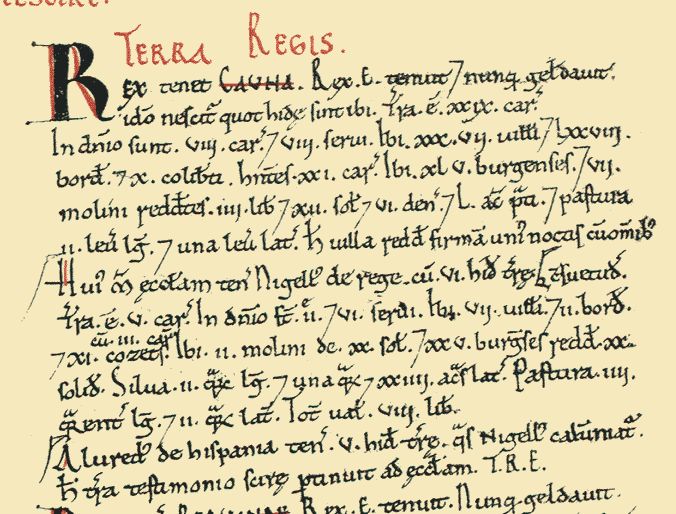
In the Domesday book of 1086, King Edward was recorded as the Lord of both towns in 1066, replaced by King William by 1086. The total population in 1066 was 114.5 households, which made this a very large population in comparison to other towns recorded.
Calne entry, Domesday book 1086.
Source: http://opendomesday.org/place/ST9971/calne/
This included 44 villagers (who had the most land), 80 smallholders (who had less land than the villagers), 14 slaves, 10 freedmen, 70 burgesses, and 11 recorded as other population. It was also recorded that Calne has 34 ploughlands, which is land that could be ploughed within a year by an 8 oxen plough team. In Calne this was made up of 10 lord's plough teams and 24 men's plough teams. Other resources to be found in Calne at this time were 50 acres of meadow, 9 mills at a value of 5.62, 1 church and 6 church lands.(11)

There doesn't seem to be any evidence of Norman building in Calne until they built an arch, a transept, and nave at St Mary's and added five-bay arcades in around 1160CE, which occurred at a church already standing on this location. For a people known to destroy whole streets to add a castle here or a church there, this seems quite delicate. So, perhaps, for the common people of Calne, life after 1066 was much the same as prior to the Norman invasion?

As we can see, Calne has been a valued place ever since historical records began. From a small hamlet owned by the king, it was built up into what was considered a large settlement by the time of the Domesday book. Over the next centuries, Calne would grow and prosper, but most importantly, it would persevere and become stronger in the face of diversity times of major ecomomic strife.

References:

1: Calne, Past and Present: August 2017. 2018. Calne, Past and Present: August 2017. [ONLINE] Available at: https://calnepastandpresent.blogspot.com/2017/08/. [Accessed 26 June 2018].
2: Haslam, J., 2010. Early Medieval Towns in Britain C700 to 1140. Shire.
3: History Borough Town Calne by A E W Marsh
4: Place Names of Wiltshire, Gover et al, 1939
5: Anna Powell-Smith. 2018. Calne | Domesday Book. [ONLINE] Available at: http://opendomesday.org/place/ST9971/Calne/. [Accessed 26 June 2018].
6: Place Names of Wiltshire, Gover et al, 1939
7: The borough of Wilton: Introduction | British History Online. 2018. The borough of Wilton: Introduction | British History Online. [ONLINE] Available at: http://www.british-history.ac.uk/vch/wilts/vol6/pp1-7. [Accessed 26 June 2018].
8: History of Wilton | Wilton Town. 2018. History of Wilton | Wilton Town. [ONLINE] Available at: http://wiltontown.com/history-of-wilton/. [Accessed 26 June 2018].
9: Hourihane, H., 2012. The Grove Encyclopedia of Medieval Art and Architecture. Oxford Univ Pr.
10: Turner, S., 2018. The History of the Anglo-Saxons (Cambridge Library Collection - Medieval History) (Volume 2). Cambridge University Press.
11: Anna Powell-Smith. 2018. Calne | Domesday Book. [ONLINE] Available at: http://opendomesday.org/place/ST9971/calne/. [Accessed 26 June 2018].

03/11/2017

Book Review: Who was Ingen Housz Anyway? by Norman and Elaine Beale

This short book is a wonderful introduction to the life and times of scientist Jan Ingen Housz, who lived in Calne for a time.

While the main body of the book is only 36 pages, the authors have packed in a great deal of well written information and interesting illustrations and photographs. Beginning with the origin of the Ingen Housz surname along with Jan's birth and situation, the book progresses with Ingen Housz's rise as a smallpox inoculator and the lifelong friends he makes along the way.

From being headhunted by royalty for his expertise in inoculation to eventually self-exiling himself back in England during the time of revolution - and violence - on the continent, this man had a colourful life. But that's just some of what happened to him, not the things he did.

The book goes on to explain the experiments that are the foundation of what we understand about photosynthesis, through Ingen Housz's experiments at a rented country house in Southall Green, just outside London, and the role of carbon dioxide in the creation of organic matter.

The book concludes with the memorial in St. Mary's Church in Calne that occurred in 1956 and describes the plaque placed there in Ingen Housz's honour.

That such a man of science spent time in the area of Calne, but is basically forgotten is terrible, to my mind. Such good treatment of Ingen Housz made this a really enjoyable book to read: it was long enough to get across a lot of information, but not so long as to get bogged down in too much detail.

This book is available to loan from Wiltshire library.

03/10/2017

'Two Pigs' Statue stolen from Phelps Parade, Calne

The Two Pigs sculpture. Photo Credit: Rodhullandemu.
I was saddened when my wife returned home from shopping and told me that the much loved 'Two Pigs' statue had been stolen from Phelps Parade sometime the previous evening.

Wiltshire Police report that the statue was taken sometime between the evening of Sunday 1 October and the early hours of Monday 2 October.[1]

Calne Town Council CCTV [2], run by volunteers and when unmanned runs on a pre-set patrol, have given the police the CCTV coverage of the area and the police have been reviewing the footage. Two CCTV cameras recorded the theft, which only took 2 minutes and 45 seconds, suggesting (to me, at least) a level of premeditation to this theft. The statue was wrenched off and carried to a vehicle, Tony Trotman, the current Mayor of Calne commented [3]. The mayor also write in a Facebook comment that the statue was "cast in hollow form and the bronze is not to be thought as an expensive material in scrap terms". The police are asking anyone with information to call 101 or Crimestoppers on 0800 555 111.[4,5]

In an attempt to reduce the likelyhood of other pieces of Calne public art being stolen, a jointly funded Wiltshire Police CCTV van will be deployed into the town centre for the foreseeable future.
 
The aftermath. Photo Credit: Lucy Havenith
Some History
The bronze statue was placed in Phelps Parade in 1979. It replaced a birch tree which was planted in 1973 upon the completion of Phelps Parade, the same year that the centre of Calne became a conservation area. The tree didn't last long [6], but I had just assumed that this statue would be here for a time long enough to be considered 'forever'.

The statue was commission by the Calne Civic Society (sadly no longer with us) as Calne's first piece of public art. It was made by a prolific local sculptor, Richard Cowdy, who also created the sheep bronzes outside of Sainsbury's in the town along with having a hand in creating most of the public art in Calne.

 This statue was created as remeberance of the town's history with the Harris bacon business. The business evolved from a family butchers in the late 1800s to  become a major employer in Calne, employing up to 2000 people and processing 5000 pigs at its peak. Recession and competition (from Danish industry) had a massive effect on this business and the loss of major customer, M&S, lead to the factory closing. It was demolished in 1984 to make way for the redevelopment in the town, which lead to the development of Beach Terrace and the library.


What will happen now? 
At the time of publishing this post, the police are progressing enquiries. In the long run, it's doubtful that our town will get back our beloved and unique bronze pig statue. I can only hope that they will be replaced by a replica or something that will bring just as much joy to the residents of the town. Whether this will be done by the Town Council, a benefactor, or by public subscription, who knows?

I'm lucky that my last memory of this statue is my 2 year old son sitting on the statue and pretending to ride the pig as a horse, as I'm sure many had done in the past. But, sad to know that this is the past and won't happen again. 

Perhaps it is time to leave the past behind. Calne has come a long way since the days of Harris and is more resilient since those days. - Who am I kidding: We want our pigs back.

I hope you will enjoy this video about the bronze pigs by Pete Steadman via YouTube:


An exciting update to this story can be seen here.
Post updated: 24/04/2018 with additional photographs. 

References and Notes: 


[Photograph] File:CalnePigs.jpg - Wikimedia Commons. 2017. File:CalnePigs.jpg - Wikimedia Commons. [ONLINE] Available at: https://commons.wikimedia.org/wiki/File:CalnePigs.jpg. [Accessed 03 October 2017].
[1] Theft of pig statue from Phelps Parade, Calne. 2017. Theft of pig statue from Phelps Parade, Calne. [ONLINE] Available at: http://www.wiltshire.police.uk/news/4175-theft-of-pig-statue-from-phelps-parade-calne. [Accessed 03 October 2017]. 
[2] Calne Town Council. 2017. In Facebook Calne Town Council. Retrieved October 3, 2017, from https://www.facebook.com/CalneTC/posts/1479990152088974
[3] Tony Trotman. 2017. In Facebook Calne Town Council. Retrieved October 3, 2017, from https://www.facebook.com/CalneTC/posts/1479990152088974?comment_id=1480097768744879&notif_id=1507041561739254&notif_t=feed_comment
[4] BBC News. 2017. Bronze pig sculpture stolen from Wiltshire pork pie town - BBC News. [ONLINE] Available at: http://www.bbc.co.uk/news/uk-england-wiltshire-41467016. [Accessed 03 October 2017].
[5] The Wiltshire Gazette and Herald. 2017. Tribute to Harris Bacon company been stolen from Calne | The Wiltshire Gazette and Herald. [ONLINE] Available at: http://www.gazetteandherald.co.uk/news/15570496.Bronze_pig_statue_stolen/. [Accessed 03 October 2017].

[6] A photograph of the tree in place can be seen in Calne's Heritage by Peter Treloar, page 126. ISBN: 978 0 7524 5144 2. Available to loan from Wiltshire library and to buy online.


28/09/2017

Book Review: Calne in Camera, Calne in Pictures, Calne in Focus by Peter Treloar

I have decided to review this trilogy of books together as they follow a very similar format and content.

This series of books really should be considered a triumph for Calne as they show the changes of Calne throughout time, and that people cared enough about the town to not only take these photographs, as well as preserve them for such a long period of time.

Many of the photographs in these books are well over 100 years old, with some displaying the town and its residents in the late 1800s. The author, Peter Treloar, has chosen some wonderful photographs to display the Changing Face of Calne, Haulage and Transport, Events and Celebrations, Commerce, and Groups - along with other topics. But these photographs without context would be meaningless to today's audience as many are beyond living memory. This is where the well written captions of the author bring life to the photographs for readers such as myself.

These captions really shine in the third book, Calne in Focus, as they are longer and provide much more detail. Another great development by the third book is the comparison photographs the author took. By taking an old photograph and placing it alongside a current (1984) photograph taken at as close as possible to the same location and angle, we can easily see the changes that have happened during the intervening time period. Treloar describes the changes between the two as only a knowledgeable local could.

A great read with fantastic photographs.

The books were reprinted in 2003 and some are for sale in the Visitor Information & Community
Information Centre as well as the Calne Heritage Centre. They are also available to loan from Wiltshire Library.

29/08/2017

Calne: First written reference and name origin

Eadred - MS Royal 14 B VI
Saxon King Edred
The earliest known reference to Calne in writing is within the Will of King Edred (also Eadred). This Saxon king lived between 923 and 23 November 955 and was the grandson of Alfred the Great.

Within his Will, he leaves the estates of Downton, Damerham, and Calne to the Old Minster at Winchester. It would seem that at least since the 9th century, Calne was owned by royalty and had Crown property in the town (then probably no more than a hamlet).

While the first documentary evidence for our town name appears in 955, A Dictionary of British Place Names states that the name is pre-English. So, it is likely that the name was well established by the time of Edred's will. Ekblom (1917) states:
'This name must be Celtic, probably the same word as Colne, Lancs. 
(occurring as Calna, Caune in the 13th cent.)'.

The origin of the name Calne is not known for certain, but is thought to be named after the river 'Calne', from the Celtic elements Col-aun, which means meeting or current of waters. This meeting is likeley Abberd Brook and the River Marden. If the 'Cal' element of Calne and Calstone have the same origin, then it would make 'Calne' the ancient name for the River Marden, the source of this river being Calstone Wellington. However, it is not known how the river became known as the Marden.


Interestingly, Colne in Lancashire, which in 1124 was known as Calna (in 1091, Calne was also refered to as Calna). A Dictionary of British Place-Names advises that Colne is a pre-English river-name of uncertain meaning - identical with River Calne in Wiltshire.

While we may never know the true origin of the name of our town, with place and river names changing, along with the development of language over time, we do know that it is truly ancient.


To discover more about the place names of Calne, buy the book:

References:
Ekblom, E (1917) The Place-Names of Wiltshire. Upsala. APPELBERGS BOKTRYCKERI A-B.
Goold, P. (n.d.). King Eadred of Wessex. Somerset Archaeological and Natural History Society.
Marsh, A. (1904). A history of the borough and town of Calne. Calne: R.S. Heath.
Mills, D. (2011). A Dictionary of British Place-Names. Oxford. Oxford University Press.
Treloar, P Q (2003) Calne in Camera. Calne. Redpin Publishing.
Mills, D., 2011. A Dictionary of British Place-Names. 1st ed. Oxford: Oxford University Press.